
RECENT SEARCHES
Recently Viewed
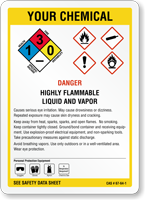
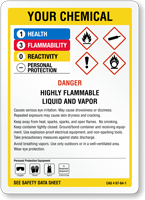

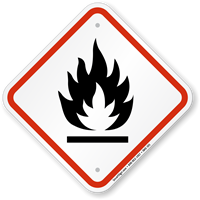
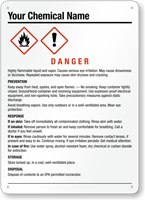
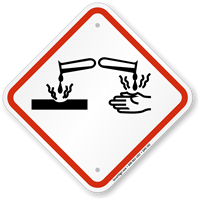
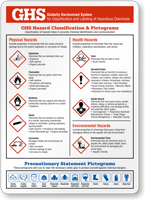
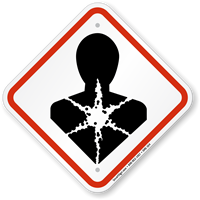
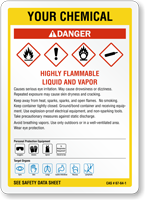
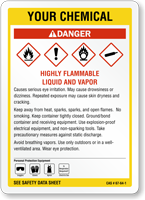

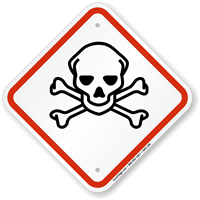

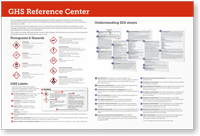
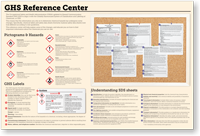
GHS signs use a standardized set of pictograms and signal words to communicate chemical hazards, following the Globally Harmonized System of Classification and Labelling of Chemicals. GHS signs are critically important for workplace safety because they provide a universal, easy-to-understand warning system that any worker can recognize, regardless of the specific facility or chemical involved.
The correct GHS pictogram for a specific chemical is determined by that chemical's hazard classification, which can be found on its Safety Data Sheet (SDS). Browsing all nine standard GHS pictograms is also a reliable way to identify the correct GHS symbol for a given hazard class.
Yes, GHS signs and labels on this page are designed to be fully compliant with the current OSHA Hazard Communication Standard (HCS), 29 CFR 1910.1200. OSHA's 2024 final rule updated the HCS to align primarily with the seventh revision of the GHS, replacing the older 2012 update that had aligned with GHS Revision 3, so GHS signs on this page reflect the current federal standard rather than an outdated one.
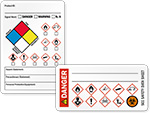
For GHS labels placed on chemical drums, durable, chemical-resistant vinyl is generally recommended, since vinyl GHS labels adhere well to curved surfaces and withstand industrial handling better than paper-based alternatives. Our selection of GHS labels is designed to adhere to a variety of surfaces and withstand industrial conditions.
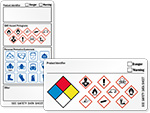
Yes, customizable GHS signs are available that can be adapted to meet specific facility requirements. A customizable GHS template lets you add a specific chemical name, select the correct pictograms, and include additional hazard information such as CAS numbers or personal protective equipment requirements.
GHS signs should be placed at the entrance to chemical storage areas, directly on containers and drums holding hazardous substances, and near workstations where employees handle regulated chemicals. Posting GHS signs in these locations ensures workers see the hazard pictogram and signal word before coming into contact with the chemical, giving them time to review the Safety Data Sheet if needed.
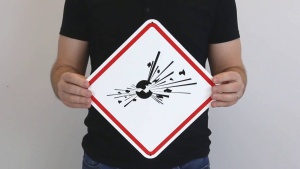
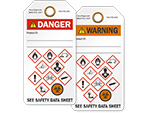
The nine GHS hazard pictograms cover flammable, corrosive, toxic, health hazard, environmental hazard, compressed gas, explosive, oxidizing, and exclamation-mark (irritant) hazards, each represented by a distinct black symbol inside a red diamond border. GHS signs featuring these pictograms are available individually or combined onto a single custom GHS sign when a chemical presents more than one type of hazard.
A GHS sign is a physical, posted warning that uses pictograms and signal words to communicate a chemical hazard at a glance, while a Safety Data Sheet (SDS) is a detailed written document containing full information on a chemical's properties, handling procedures, and emergency response steps. GHS signs and SDS documents work together under the OSHA Hazard Communication Standard, with the GHS sign providing an immediate visual warning and the SDS providing the in-depth reference material behind it.
Ensure full hazard communication compliance and protect workers from chemical risks with GHS signs that implement the Globally Harmonized System of Classification and Labelling of Chemicals across your facility in a clear, standardized, and internationally recognized format. The GHS system was adopted by OSHA as the foundation of its Hazard Communication Standard, making GHS compliant signage a legal requirement for any facility that manufactures, handles, stores, or uses hazardous chemicals in the workplace.
Call our sales team at (800) 952-1457 and get your quote in minutes!
Mon - Fri 8:00am to 7:00pm EST
Best price guarantee. Fast, free shipping.